Reaction to the Burney Relief
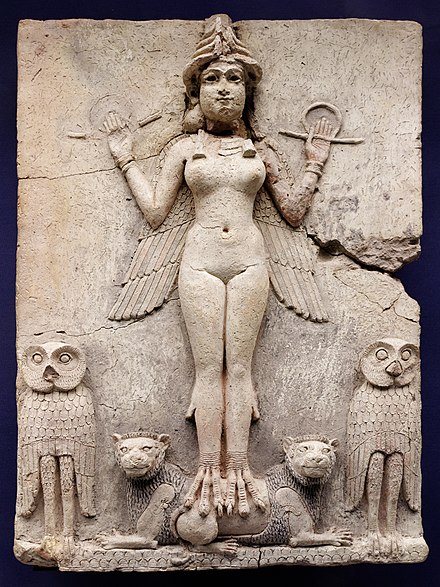
The Burney Relief, or “The Queen of the Night” fascinates the viewer because of the symbolism used in the sculpture, its odd history and the myths surrounding its subject. Seeing this female figure standing on the backs of lions and holding out her arms from her nude form with strength and vitality reminds one of power and integrity, courage and vigor.
Timeline
Imagine being transported to the faroff time of 1750 BC. You are in the bustling kingdom of Babylon under the rule of King Hammurabi and the Gods of Heaven reign supreme.
In the book of Revelation, according to Dr. McDonald, Babylon is supposed to enjoy a reputation in the modern world as the abode of harlotry and depravity. “It is cursed by the Bible.” Dr. McDonald says that “examining the history reveals quite a different picture.”
The home of this sculpture was the place where the law code of Hammurabi, which is in many ways the basis of modern law, was created. People there were supposed to respect the Gods and their priests and rulers.
The King himself said that he ruled under God and was therefore a subject himself. He was said to have conquered all of the Near East and ruled effectively until the time of his death.
Hammurabi formed the kingdom of Babylon with the goal of ensuring the happiness of the people. As Dr. McDonald discusses, under his rule many improvements were made to the infrastructure which made living better for his people. Although a warrior, the King brought peace and stability to the people in the kingdom.
The Sculpture
The sculpture is full of symbolism and strength..
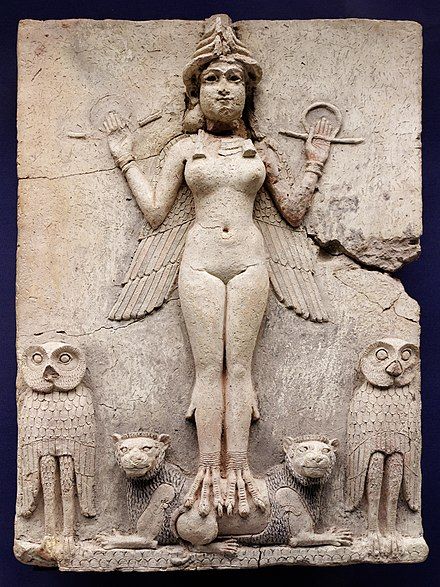
The figure is of a voluptuous female with a curvy body and symmetrical features. Her breasts and hips depict youth and health as they are full and round. She has smooth skin which also points to health.
She has animal features, too. Her down turned wings resemble those of a predatory bird and to complement this she has bird feet with talons that could tear open a victim.
According to the British Museum website, she has many accessories that support the idea that this sculpture is of the Goddess. Her headdress symbolizes her divinity, and her bracelets and necklace suggest great power.. Also, the rods and rings in her hands symbolize justice which means that she is powerful indeed.
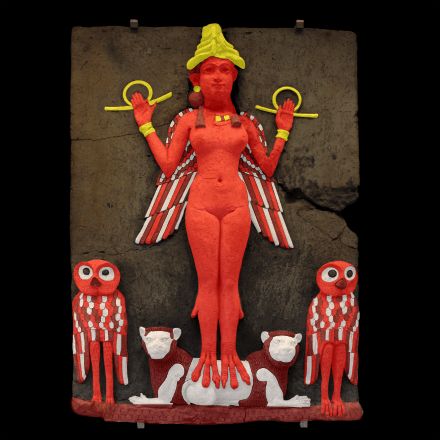
There is some paint residue on the sculpture so experts have been able to determine what it might have looked like. This picture describes that theory. Dr. McDonald presents a similar rendering in her lecture.
The high relief sculpture (which means that it was moulded so that the figure’s features extend outwards from the surface) is made of straw tempered clay. That means that the clay was mixed with straw to keep it strong and firm.
It measures 20 by 15 inches. Some experts, according to McDonald suggest that it could have hung in a bordello, but other sources at the British Museum say that it could have been made to hang in a shrine.
Either way, wherever it was placed, it commands attention. The lions were used by the Babylonians to accompany Ishtar. The owls were tied to the night. The small platform is supposed to mean the mountains which according to recognized experts was the home of the Gods.
Controversy
Is it Ishtar or her sister goddess?
Some say that this sculpture is not of Ishtar but of her sister who is said to rule the underworld. McDonald makes a great point that the Babylonians didn’t make sculptures of demons or this type of sculpture of demons, so it doesn’t seem to be her sister.
Then, Ishtar was always shown with lions. Her standing on the backs of these lions in a non-threatening way implies that these are her lions. Her talons do not scar or injure the lions but only stand on them.
Some experts say that the fact that the wings turn downwards mean that she is the sister because they symbolize the underworld when placed that way, but according to the Brooklyn Museum’s research on myths surrounding Ishtar particularly their work on Gilgamesh reference the myth of her descent to the underworld with her lover Dumuzi. It is reasonable to think that it is Ishtar within that narrative space.
Is it authentic?
Another controversy surrounding this sculpture focused on whether it was even real. All sources indicate that thermoluminescence testing revealed it’s authenticity in 1933.
This type of dating uses radiation to determine the age of pottery. It examines the material’s composition to pinpoint when the clay was subjected to heat in order to create the sculpture. The British Museum performed this test in 1933 and judged it authentic from the Old Babylonian Period.
Related Works
Two related works exist: one is at the Louvre and the other at the British Museum, too.
There is a vase at the Louvre with another depiction of Ishtar. On the vase are drawings of birds and fish. Ishtar is shown on it with similar birdlike feet but there they are not as finely rendered.
Also at the British Museum is a “small, crude plaque” with a goddess depicted with down turned wings and the crown of divinity. It is also clay.
References
The British Museum, “The ‘Queen of the Night’ relief,” in Smarthistory, February 26, 2021, accessed May 17, 2024, https://smarthistory.org/the-queen-of-the-night-relief/.
Brooklyn Museum, “Ishtar,” (n.d.), accessed 17 May, 2024, https://www.brooklynmuseum.org/eascfa/dinner_party/place_settings/ishtar#:~:text=A%20multifaceted%20goddess%2C%20Ishtar%20takes,shown%20winged%20and%20bearing%20arms.
Diana McDonald, PhD, “Queen of the Night, Babylonian Goddess,” 30 Masterpieces of The Ancient World, Great Courses, 2013.
 Rule Creations