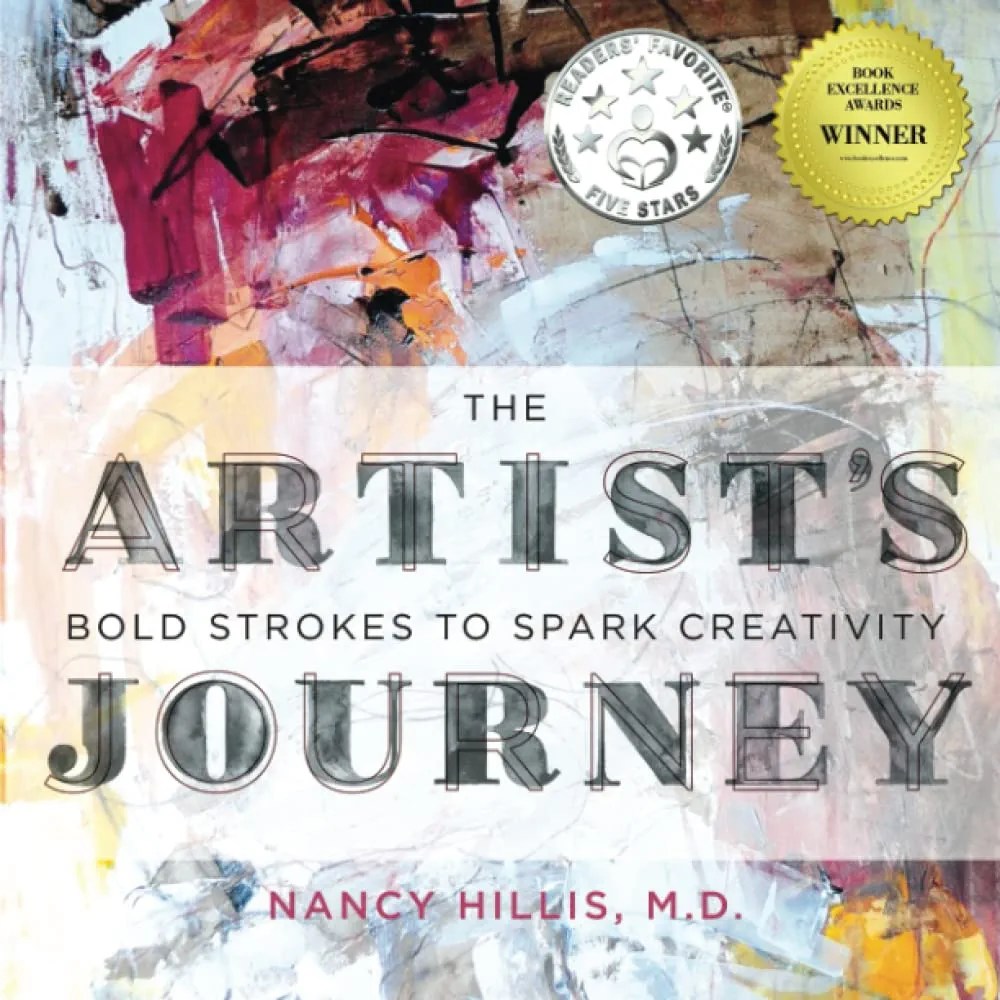
Summary of the book’s contents
The Artist’s Journey is not an instructional manual for technique, nor is it a biography of a specific artist. This book discusses what goes into freeing the mind from inhibitions to tap into the inner source of creativity.
Hillis is a trained therapist who worked with existential psychology for years before the art bug caught her. She helped many people and uses this experience within the book.
It is structured in different parts with each containing an exercise that will help guide down into the core of the artist with the goal of bringing authenticity to the artist.
It assumes some experience as an artist and skill in the chosen medium. Most of the exercises center around painting.
Personal response to The Artist’s Journey
Responding to this book was relatively easy. I enjoyed the writer’s style and ability, liked the organization of the content and agreed with her philosophy.
I especially liked the exercises. Although I am not a painter, I used her techniques with my writing to great effect. The first exercise for example centered around drawing a mind map surrounding the word “ugly.” I used it to write an essay about the emotion of sorrow which I find to be “ugly.”
She reminds us in this section that the term “ugly” has a meaning that changes over time and from person to person. “Sorrow” has been the subject of many paintings. They are beautiful, but to me, the contortions that sorrow performs on a countenance leave it strained and sometimes grotesque.

This painting by Cezanne always makes me think of the sorrow in a tragic relationship. It is called Pierrot and the Harlequin (1888)..
Connections with other books and philosophies
When I first started reading this book, I kept recalling The Artist’s Way by Julia Cameron. It is a different book because of its back story. While Cameron came to the writing of what is transformative text for artists through happenstance and personal trial, Hillis did so for other reasons. Cameron was a successful screenwriter while Hillis was in the medical profession.
Another connection came from the ideas about freedom that I talk about with my husband. He is a painter and successful author. He says that many times, he pursued projects that interested him for the love of writing and abandoned his particular genre. This made it difficult to market his work, but led him to feel free. Feeling free leads to better art.
Finally, I enjoyed her references. She cited quite a number of influential thinkers. Clarissa Pinkola-Estés, Carl Jung, Joseph Campbell and Shakespeare to round out the list. She had numerous references to music, film and books that placed her squarely in the middle of the grand conversation surrounding art and its making.
Useful 🌹🌹🌹🌹
 Rule Creations