Point of view and focal points are planned and constructed by the artist with a specific purpose in mind
Thinking about point of view and focal points when analyzing or looking at a work of art can bring great enjoyment and appreciation for the work. In thinking about how the artist structured the figures in the painting or sculpture, one can get more satisfaction from the painting.
What are focal points, and what is point of view?
When looking at representational art, focal points and point of view direct the viewer and create a relationship between her and the subject of the work. The artist strictly controls the ways that the viewer’s attention and gaze travel across the work.
“Focal points work to predetermine the viewer’s approach to the painting,” says Hirsch. A focal point is the place in the painting where the eye is led to rest longest. A work can have more than one focal point or none at all. Sculptures can have multiple focal points that lead the viewer from one to the next as the artist intends. The key to remember about focal points and points of view is that nothing is by accident, and everything is plotted in advance by the artist.
Similarly, point of view determines where the viewer is in relation to the subject. Some artists use arches and curtains to place distance between the work and the viewer. This will create a passive stance in the viewer, as if watching the events or people portrayed from a seat in a theater.
Point of view can augment the subject by placing the viewer in a “worm’s eye view” or a “bird’s eye view.” This will create either a suggestion of power in the viewer or power in the subject. In a “worm’s eye view,” the subject is elevated in relation to the viewer and so is placed in a position of power. In these ways, the artist controls the view of the scene. In “bird’s eye view,” the person looking at the painting scenes to be looking down at the scene in the painting, while in “worm’s eye view” they are looking up. This is a deliberate choice by the artist.
Examples for discussion

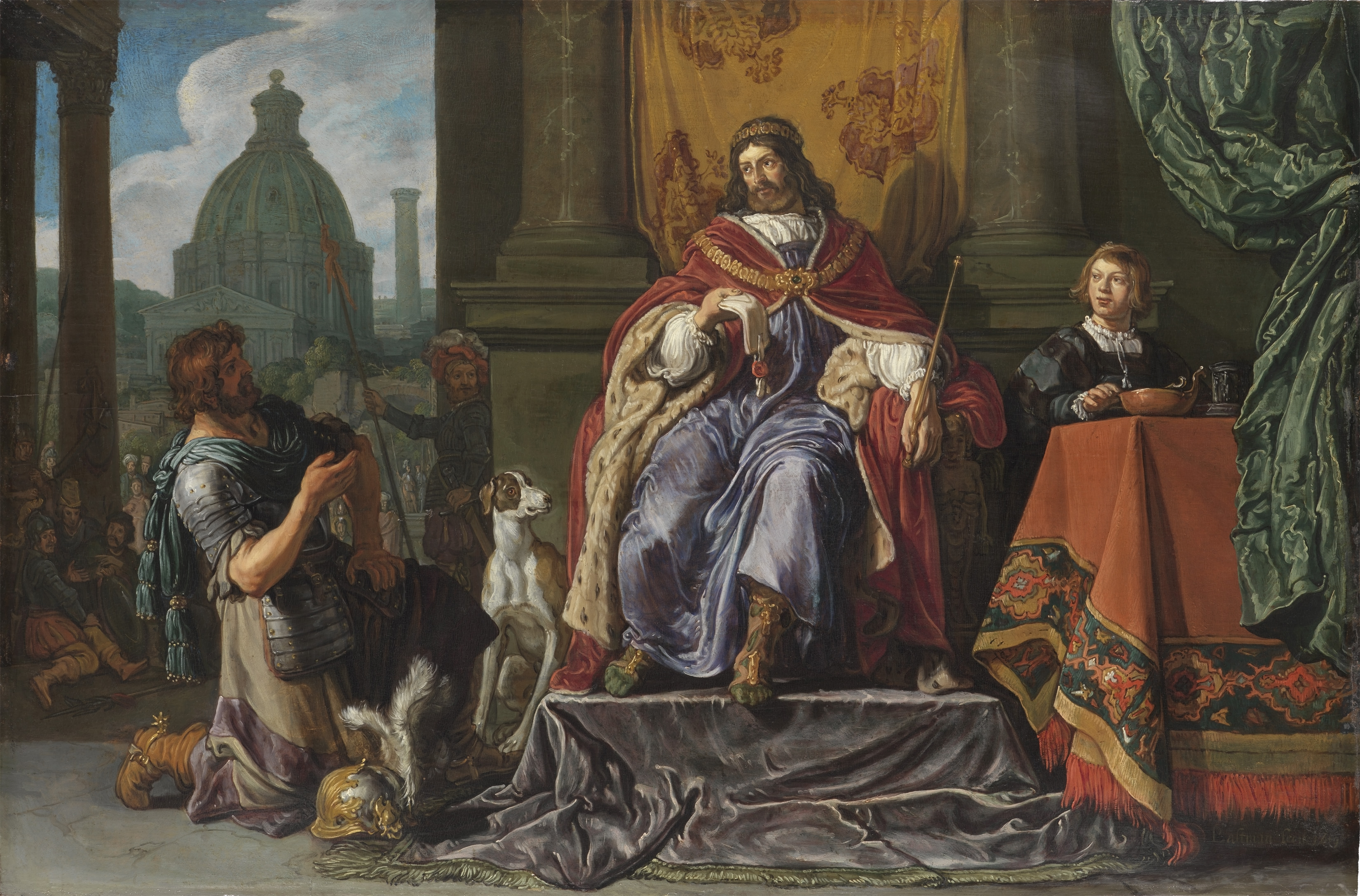
David Gives Uriah A Letter for Joab. Pieter Lastman, (1619). Using light and shadow, Lastman creates a focal point on David’s face. His gaze stares at Uriah whom he betrays, leading the viewer there too.
David. Donatello, (1440?), Bronze. In this sculpture, the focal points are many. David’s chest is wide and lead the eyes up to the face which looks down to Goliath’s head.


Relativity. Maurits Cornelis Escher, (1953). A lithograph, this work’s focal points are created by the placement of the figures on the stairs. The effect is whimsical and serves to amuse the eye. The point of view created by the skewed directions of the figures confuses the eye. In some places, the viewer looks upwards in worm’s eye view, while in the instance of the seated figure, the viewer is in bird’s eye view.

Christ of St. John of the Cross. Salvador Dalí, (1951). An incredible study in point of view, Dalí gives a viewer the chance to see Christ from the Heavens. His gaze leads the eyes down past the darkness to a morning by a river with a boat and two fishermen. The focal points are created using a variation of color and light. With this movement of focal points and play with point of view, the artist tells a story.
Christ on the Cross. El Greco, (1600-1610). In contrast to Dalí’s painting, this work has a slightly upturned point of view. The viewer looks on Christ slightly from below. Also, the undulating of the body creates a confusion. Here, Christ is alone but finally free of the bondage of the world and its suffering. His gaze tells that story as it looks to Heaven.

These are my notes from a lecture presented on Great Courses through the kind permission of my local library. It can also be accessed through Kanopy. The instructor is named Sharon Latshaw Hirsch, and she gave these lectures from Rosemont College. The title of the lecture is Where Am I? Point of View and Focal Point. Here is a link to the series. This does not constitute an endorsement and aside from personal growth, we did not gain from presenting this link.
References
Dalí, Salvador, Christ of St. John of the Cross, (1951), oil on canvas, WikiArt, 2023, https://www.wikiart.org/en/salvador-dali/christ-of-st-john-of-the-cross-1951, (Accessed June 20, 2024).
Donatello, David, (1440), bronze, Museo Nazionale del Bargello, Florence, http://www.museumsinflorence.com/musei/museum_of_bargello.html
(Accessed June 24, 24).
El Greco, Christ on the Cross, (1600-1610), oil on canvas, Getty Museum Collection, 2000, https://www.getty.edu/art/collection/object/108GFN, (Accessed June 23, 2024).
Escher, Maurits Cornelis, Relativity, (1951), lithograph, Artchive, 1998,https://www.artchive.com/wp-content/uploads/2023/04/Relativity-Escher-Maurits-Cornelis-1953.jpg, (Accessed June 24, 2024).
Graham, Heather, “Donatello’s David,” Smart History: the Center for Public Art History, https://smarthistory.org/donatello-david/ ( Accessed June 21, 2024).
Lastman, Pieter, “David Gives Uriah a Letter for Joab,” (1619), The Leiden Collection Catalogue, http://www.theleidencollection.com/wp-content/uploads/downloadable/PL-100-Pieter_Lastman-David_Gives_Uriah_a_Letter_for_Joab.jpg, (Accessed June 24, 2024).
Latschaw Hirsh, Sharon, “Where Am I? Point of View and Focal Point,” Great Courses: How to Look at and Understand Great Art,” from Hoopla, (Accessed June 2, 2024).
 Rule Creations