Featured

Growing in the Gardens

Arriving at the Pinecrest Gardens Artist Gala

It was a mild, sunny Miami afternoon, and the breezes came from secret places to whisper words of relaxation and enjoyment. We rode into the parking lot of Pinecrest Gardens.

Exterior of Pinecrest Gardens, from Web.

Gary was in business attire and had his camera fully charged and ready to work. I enjoyed being his companion at the event. It was to be a reception for some of our favorite local artists at the beautiful Pinecrest Gardens. I heard the calming sounds of people talking, glasses tinkling and music playing in the background as we entered. After checking in with reception and getting our badges, we went inside. It was there that I would learn a truth about myself and another wider truth that would help me get some sorely needed hope.

Meeting the Artists


After meeting briefly with his contact at the garden, Gary and I left the natural wonders of the garden to meet with the artists. It was at the pavilion across the lake that we would meet our first artist. Her name is Bonnier, a photographer. Her photography featured there was imaginative and surprising. There were many pictures, and all featured an illusion.

She explained how she created layers within her photos. She was so open and friendly that I felt comfortable asking her about her photos. She liked using pictures of different views of the same location and putting them together in one photo to create another new photo with a different meaning. Ghostly images lingered in corners of the pictures, adding a surreal quality to them.

Picture of rocking chair against shadowy background with superimposed image of plants.
Bonnier Photography from web

Next, we moved back to the main hall where Ferrer and Mendoza were showing their works. While Gary interviewed the artist whom he came to see, I went to talk to Mendoza. He greeted me with a smile, laughing when I talked to him about Little Havana. I asked him about his painting with the palm trees, eager to know all about it. The painting features colorful palm trees, slightly bulging at the trunk with fun and waving fronds reaching upwards into a bright blue sky. The palm images call to mind curvaceous women wearing large hats, allowing their hair to flow in the breeze. It is as happy as the artist always seems to be himself.

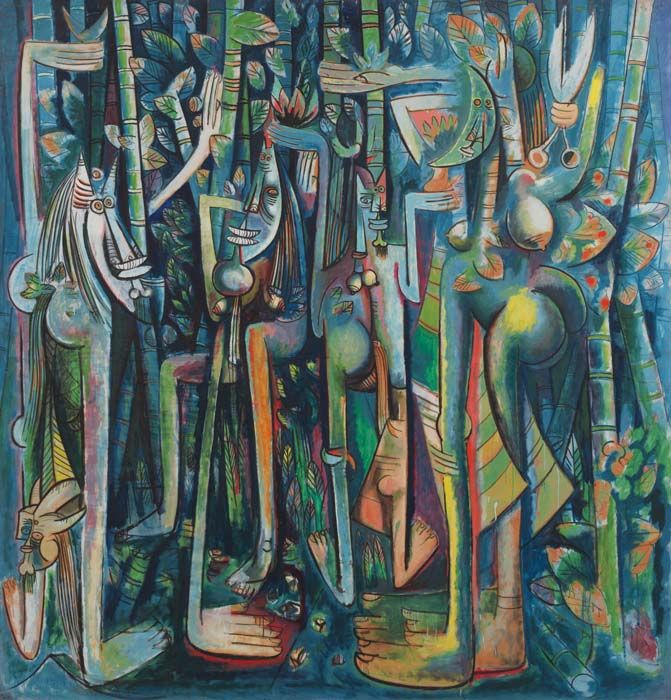
He said that it was based on another work of Wilfredo Lam called “La Jungla” that is housed in New York’s MOMA. I looked up that other painting and did not like it as much as I liked Mendoza’s. Lam’s painting had a sinister abandon to it, a hedonism, while Mendoza’s suggested the smile on a mourner’s face to pacify the children in the room.

Finally, I met Ferrer and saw her textiles. I was so swept up by them because it made me remember my mother and how she spent hours with her crochet hook and piles of yarn that she would turn into lovely creations. Ferrer explained that her piece was about a painful sacrifice. I examined the yarn work. It was complex and featured many stitches, seemingly uncountable, that looked bloody. She said that was exactly what she had intended. I was awestruck at her ability to create such an intricate piece. All the artists were open and friendly, but I felt out of sorts.

Exploring the Natural Beauty of Pinecrest Gardens


However, the surroundings made me think that everyone there should be at ease. We wandered about looking at the natural beauty of the gardens. There were honking swans that peacefully floated on the still man-made lake.

Swans Calling

Its waters were a dark blue which made the white plumage of the swans stand out more. As we watched, stately peacocks danced by, flaunting their beautiful tailfeathers. The males spread their tails wide showing off iridescent green and purple feathers. Alongside the pink coral hued walk, there were all kinds of trees and shrubs that let out a fragrance reminiscent of wild nights in the country in the Caribbean. The sound of small frogs and birds filled the air, and it was easy to relax. As the night’s sounds caressed us with their small chirps, croaks and whistles, we had fun in the garden and enjoyed ourselves.

Growth in the Gardens, Growth in the Spirit

There were other people enjoying themselves too. Everyone was milling about the area where the peacocks walked. As I walked, I thought about how much time it took for those things to grow. The trees grew and seemed to be developing just as I walked. The peacocks had once been tiny chicks newly hatched and helpless. The paintings that we saw, and the yarn work had taken time to develop. Even the master artists we had met needed time to grow and mature in their art. They learned what worked and what did not work in painting, photography and weaving. I reasoned that all had progressed while on this earth.

Garden Peace


After a few days had passed, I had started to feel like a fool for creating a blog about art when I knew so little about it. But then, after some reflection, I learned about how the experience was an important lesson in resilience. I had missed the point. In the garden, I saw how everything needed time to grow. The trees and animals, art and artists needed nurturing and sustenance to develop. I admitted that I needed to learn about art because I liked it, but that I was only a failure when I ceased to try.

“An expert is just a novice who never stopped trying.”

My truth at the time was that I knew little about art history, but the wider truth gave me hope. It was by reflecting on the works of the artists as well as the natural beauty of the garden as it all developed that I learned how important having a “growth mindset” is for staying positive and participating in the realization of personal dreams. After being introduced to this mindset by the company Tutor.com, it makes me hopeful to be participating in a process. Carol Dweck at Stanford originated this theory that a person can develop talents with perseverance and devotion. My dream is to see the beauty around me with my friends and family, enjoying each day as if it were my last.

I have only seen a minuscule portion of the world and am continually surprised by its beauty. It was because of the experience at Pinecrest Gardens that I have become reenergized about writing about art and our wonderful Miami artists.

Featured

Gary Alan Ruse Book Releases

Ruse Creates a Fierce Set of Adventures

Adventure novels take you to exciting places.

An expert at creating likable characters and placing them in dangerous situations while keeping things wholesome for a reader who may not like gore, violence or misogyny, Gary Alan Ruse has a number of novels in his list of creations.

I picked three of Gary’s novels to introduce to you today. These three books show a consistent close attention to detail, clever use of characterization and fabulous sense of dramatic tension.

These three titles are my favorites. Treasure Seekers is an adventure tale, Morlac is fantasy and Aggie and Agent X is a “blend of science fiction and mystery.”

Best of all, he created the book covers himself.

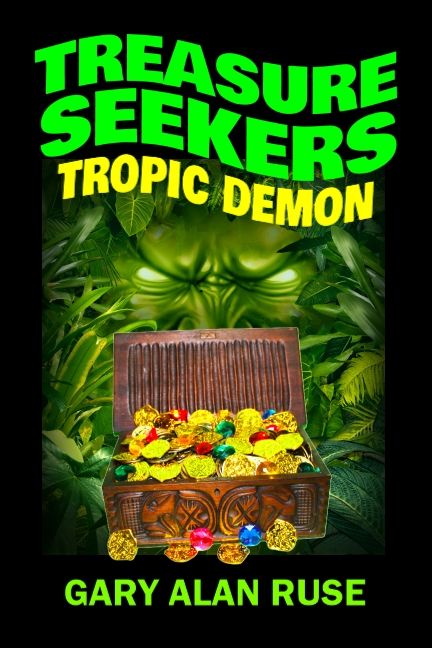
Treasure Seekers: Tropic Demon

Image from Gary Alan Ruse © 2024

Once I began reading the book, I couldn’t stop. I just needed to know what happened to Mark and the group and could not put the book down.

A mysterious creature, “a demon,” brings down the plane transporting Mark’s friend as he scouts a remote location in Africa for treasure. When Mark finds out, he is driven to find out what happened to his friend and recover a treasure.

What’s not to like?

Treasure Seekers

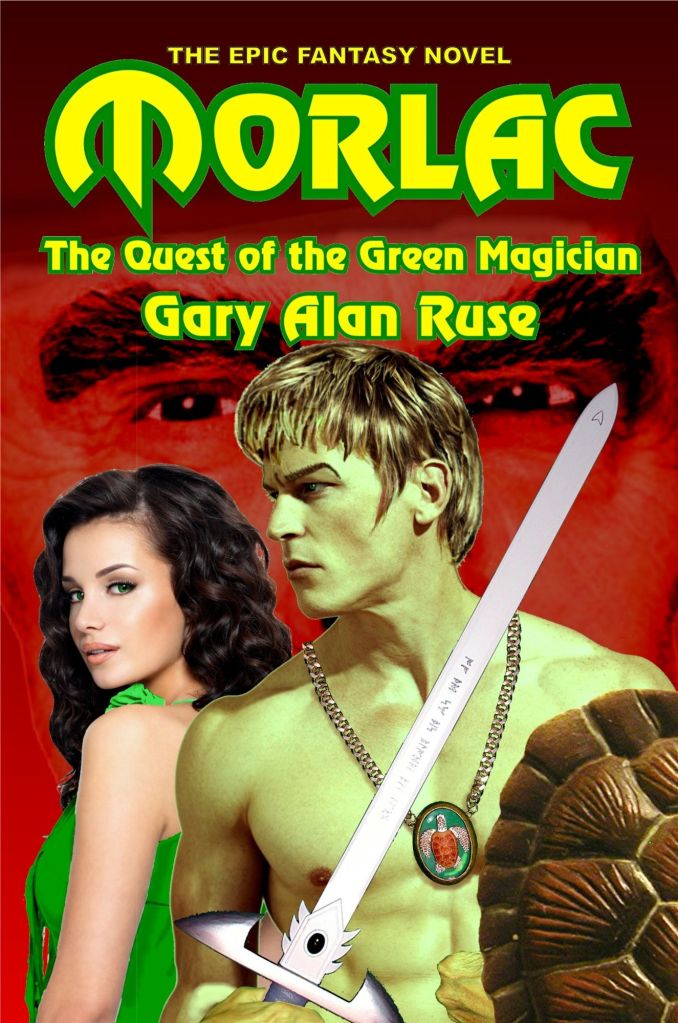
Morlac: The Quest of the Green Magician

Image from Gary Alan Ruse © 2013.

I love quests, so this book really satisfied my desires. The best thing about this book is its fairness. There is a tendency out there to create a book that ends in a cliffhanger just so the reader has to wait for the next part. This book was really like a trilogy. It had it all.

Morlac is raised from a sea creature for mysterious purposes and has to travel through magical lands to vanquish evil. Along the way, he meets fantastic beings and gains friends. There are evil mages who would like to end his quest. In the final part of the book, the magician who leads the undead against Morlac was scary.

Definitely a wonderful read.

Morlac

Aggie & Agent X

Image from Gary Alan Ruse © 2012.

This is a book that I have a special fondness for because I dressed up like Aggie for a talent show. It was so much fun. The book is a science fiction mystery genre bender.

Aggie is a CIA agent who is beginning her spy journey when she is teamed up with Agent X. It is surprising for her to learn of his many secret powers and his Top Secret origins.

Really a fun book.

Aggie and Agent X

Enjoy!

Palette of Narmer, Pharaoh

The Palette of Narmer was retrieved in Egypt at Hierakonpolis in 1898 by Quibell and Green. Along with it, the finders located another palette and three mace heads. The other palette is called the Two Dog Palette and the Mace Heads are called the Major and Minor Scorpion Mace Heads. There are many questions among art historians, Egyptologists and archaeologists about this great work of art. There is debate as to what the scenes on it represent and why it was made in the first place.

Wikipedia image, accessed September 22, 2025.


The palette depicts a scene of bloodshed and subjugation. One side is divided into three areas called registers while the other side has four registers. The largest figure on one side is of a human being wearing the crown of Upper Egypt while on the other the being wears the crown of Lower Egypt. This is thought to be Narmer because of the hieroglyphs at the top of the palette. The catfish and chisel denote his name.


The central register where Narmer stands in an aggressive pose holding a kneeling bearded figure by the hair also shows a falcon. This falcon is the God Horus. The king of Egypt was thought to embody Horus on Earth. Because the falcon has the head of the man held by a rope, scholars believe that it means that Narmer subdued the people of that group by divine right. The papyrus growing from the oblong represent the people of the Delta or Lower Egypt. On the other side of the palette, there is a register where the King walks in a procession. Before him lay the decapitated bodies of people presumed to be his enemies.

It is important, as McDonald points out, because this is the first use of registers and the poses. This way of presenting images remained the standard for the next 3,000 years. Also, the hieroglyphs used here are a new development first seen in this palette.

The palettes had a considerably mundane purpose. They were used to grind stones into powder used for eye makeup. This makeup shielded the eyes from the sun and protected them from infection. The stones were lapis lazuli and other stones soft enough to grind. On the side with the “serpopards,” or serpentine leopards as Suezcle refers to them, there is a large circular indentation. This is where the stone would be ground. This particular palette, which was 63 cm or 24 in long, was used in the temple.


Another purpose according to the scholars was something that is common to all regimes in varying degrees. Narmer used these stones to disseminate an image of himself as a bold and strong leader capable of using force effectively to conquer enemies and maintain order. These pallettes were distributed among the ruling class and served to remind them of his power and strengthen his grip.

World History.org Accessed 22 September, 2025.


The debate between scholars centers on whether the piece really can be used as a historical document that describes what happened in 3,100 BC Egypt. Some scholars like Schulmann in the 1990s argued that the piece did not convey an accurate depiction of Narmer’s powerful subjugation of the people of Lower Egypt but was actually describing an event that happened a hundred years or so before in the time of one of his predecessors. That conflicts with the widely held view pieced together by scientists beginning in the 1940s who believe that it is definitely a historical account of the unification of Egypt by force.

The scholars that argue for Narmer’s leadership during the power struggle assert that in order for the unification to have taken place at an earlier time, the palette would have to be older as would the tombs where it was found. And, it seems that Narmer would have been more likely to back the work artists during his time if they were using art to further his interests rather than those of someone 100 years in the past.

Regardless of whether the palette chronicles the rise of a unified Egypt accurately or is propaganda to support Narmer, what it shows is relevant at any time in any place. It describes a violent takeover of a people by a ruthless ruler using deadly force. The scenes of mutilation and violence were created to legitimize Narmer’s position as King of Egypt. His rule may have lasted as long as 62 years.

Other finds at Hierakonpolis and Abydos in Egypt

Thanks for reading! ☺️ Sources available on request.

Art History for Everyone by Kristine TG Hardeberg: Book Review

Here is a book review for those interested in learning about art history from antiquity up until the great Impressionists.

Review: Art History for Everyone by Kristine TG Hardeberg

Art History for Everyone is a fun and accessible introduction to the subject of, guess what, Art History. It is for people who find art difficult to understand but want to know more about it. The author is Kristine T.G. Hardeberg from Norway who is an author, speaker and influencer. She gives lectures, courses and sells books online.

Unlike some nonfiction books about Art History this book is presented as an “exciting discovery trip into the world of art.” “Art History,” she says “seems foreign to many people,” so she suggests that an art history newcomer should become an explorer, proceed with child-like curiosity and use the “restaurant method.”

“The restaurant method,” she describes in her introduction, is the proper way of approaching a visit to a museum or to a gallery. She said that a little planning and examination of the material given at the museum will give an idea of what to look for while there rather than wandering around trying to take it all in and becoming tired and frustrated. Like a visit to a restaurant, one would choose a dish that means something on a personal level rather than ordering everything on the menu.

In her book, she begins with a brief tour of the world of antiquity, but it is in the content about Renaissance Art that she truly begins her exploration. She continues through each period with ease and clarity until arriving at Impressionism where she stops. All the while, she includes many pictures.

I had an ebook, so I had one problem with viewing these pictures. The formatting functions on my eBook reader laid out the wider paintings on more than one screen at times, so that it was difficult to take them in. Viewing these larger works in this way was therefore not really a thoroughly satisfying experience. I am sure that the hardcover edition did not present such a problem. The actual contents of the book were engrossing and truly a lot of fun. She gave lots of information about the prominent artists in each period and also analyses of their major works.

Hardeberg accomplishes her goal of presenting Art History to interested people in a fun and exciting way.

This book is available on Amazon, Thrift books and other locations. I am not receiving compensation for mention or review of this book. Enjoy.

YoungArts and a National Award for Artists Aged 15-18

It all started with President Jimmy Carter who issued an Executive Order to expand the United States Presidential Scholars Program to include the visual and performing arts and creative writing. This happened in 1979.  At first, the Educational Testing Service that administers the SAT’s was responsible for running the competition. Soon however, Ted and Lin Arison gave a 5 million dollar donation to establish the National Foundation for Advancement in the Arts and took over the competition in 1981.

From there the competition has turned into a mentoring, community building and development program for young artists and has helped thousands of performing, visual and literary artists aged 15 to 18 compete. YoungArts has led many of them to earn United States Presidential Scholars in the Arts Awards. The next competition will be held on January 4th- 11th, 2026.

Upon winning this award young artists are eligible for mentorship and a $10,000 prize. Ted Arison believed strongly that the arts were important to the nation.

“I think that the arts are the soul of our nation. I felt that the arts had almost become an endangered species and I realized, especially with young people, that YoungArts will ensure the future of our soul,” he is quoted as saying on the organization’s website.

YoungArts features 10 disciplines: classical music, dance, design, film, jazz, photography, theater, visual arts, voice, and writing. From the competition the alumni and other members of YoungArts have created a series on HBO entitled YoungArts Masterclass. A documentary was also created entitled Rehearsing a Dream that was made about the foundation. For more information visit youngarts.org.

Is this your new site? Log in to activate admin features and dismiss this message
Log In