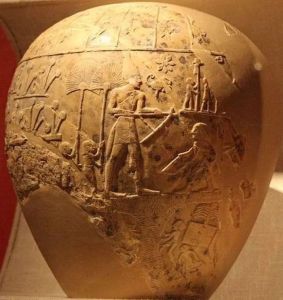
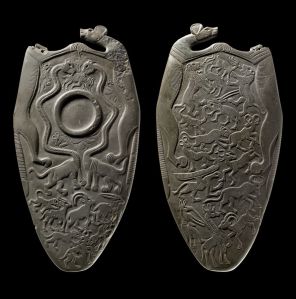
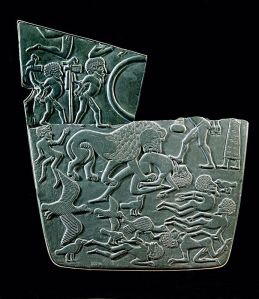
The Palette of Narmer was retrieved in Egypt at Hierakonpolis in 1898 by Quibell and Green. Along with it, the finders located another palette and three mace heads. The other palette is called the Two Dog Palette and the Mace Heads are called the Major and Minor Scorpion Mace Heads. There are many questions among art historians, Egyptologists and archaeologists about this great work of art. There is debate as to what the scenes on it represent and why it was made in the first place.
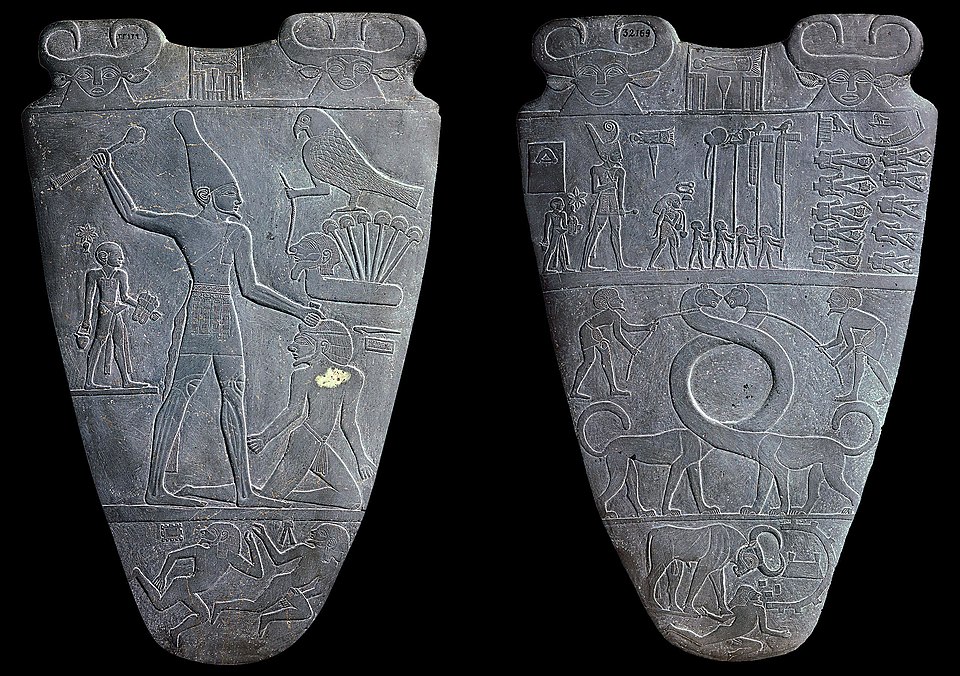
The palette depicts a scene of bloodshed and subjugation. One side is divided into three areas called registers while the other side has four registers. The largest figure on one side is of a human being wearing the crown of Upper Egypt while on the other the being wears the crown of Lower Egypt. This is thought to be Narmer because of the hieroglyphs at the top of the palette. The catfish and chisel denote his name.
The central register where Narmer stands in an aggressive pose holding a kneeling bearded figure by the hair also shows a falcon. This falcon is the God Horus. The king of Egypt was thought to embody Horus on Earth. Because the falcon has the head of the man held by a rope, scholars believe that it means that Narmer subdued the people of that group by divine right. The papyrus growing from the oblong represent the people of the Delta or Lower Egypt. On the other side of the palette, there is a register where the King walks in a procession. Before him lay the decapitated bodies of people presumed to be his enemies.
It is important, as McDonald points out, because this is the first use of registers and the poses. This way of presenting images remained the standard for the next 3,000 years. Also, the hieroglyphs used here are a new development first seen in this palette.
The palettes had a considerably mundane purpose. They were used to grind stones into powder used for eye makeup. This makeup shielded the eyes from the sun and protected them from infection. The stones were lapis lazuli and other stones soft enough to grind. On the side with the “serpopards,” or serpentine leopards as Suezcle refers to them, there is a large circular indentation. This is where the stone would be ground. This particular palette, which was 63 cm or 24 in long, was used in the temple.
Another purpose according to the scholars was something that is common to all regimes in varying degrees. Narmer used these stones to disseminate an image of himself as a bold and strong leader capable of using force effectively to conquer enemies and maintain order. These pallettes were distributed among the ruling class and served to remind them of his power and strengthen his grip.
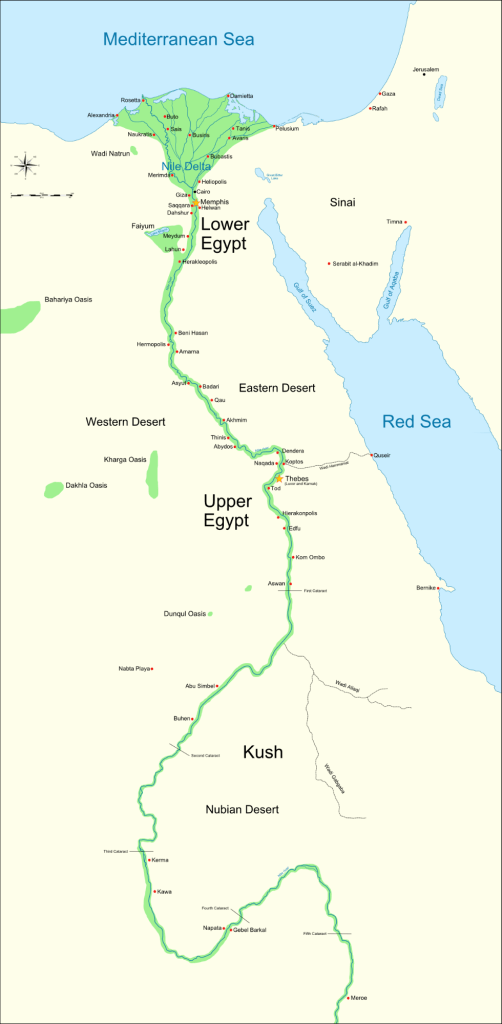
The debate between scholars centers on whether the piece really can be used as a historical document that describes what happened in 3,100 BC Egypt. Some scholars like Schulmann in the 1990s argued that the piece did not convey an accurate depiction of Narmer’s powerful subjugation of the people of Lower Egypt but was actually describing an event that happened a hundred years or so before in the time of one of his predecessors. That conflicts with the widely held view pieced together by scientists beginning in the 1940s who believe that it is definitely a historical account of the unification of Egypt by force.
The scholars that argue for Narmer’s leadership during the power struggle assert that in order for the unification to have taken place at an earlier time, the palette would have to be older as would the tombs where it was found. And, it seems that Narmer would have been more likely to back the work artists during his time if they were using art to further his interests rather than those of someone 100 years in the past.
Regardless of whether the palette chronicles the rise of a unified Egypt accurately or is propaganda to support Narmer, what it shows is relevant at any time in any place. It describes a violent takeover of a people by a ruthless ruler using deadly force. The scenes of mutilation and violence were created to legitimize Narmer’s position as King of Egypt. His rule may have lasted as long as 62 years.
Other finds at Hierakonpolis and Abydos in Egypt
Thanks for reading! ☺️ Sources available on request.



 Rule Creations